

What Is My IQ? How To Test And Improve It In 2025

Rebecca Gayle Contributor / Dec 15, 2025
Wondering 'what is my IQ'? IF you are searching for an IQ Test, you find nothing but an endless series of dubious tests and bogus scores that make you unsure about whether you actually ought to know it. This guide helps with both: first, we'll help you find a reliable test, and then we'll look at ways to use that answer to train and boost your memory, focus, and problem-solving abilities through targeted brain training activities.
Reviewed by Ron Spinabella, Editor in Chief


What Does “IQ” Actually Measure?
Before you seek a test, it's crucial to understand what you're measuring. IQ (Intelligence Quotient) is a score designed to measure human intelligence. It's not about what you know, but how you think. Modern IQ tests typically assess key cognitive abilities like:
Logical Reasoning: Your ability to solve novel problems and identify patterns.
Working Memory: The amount of information you can hold and manage productively in your mind at once.
Processing Speed: The rate at which you can process simple cognitive tasks and do so correctly.
Verbal Comprehension: The ability to comprehend and communicate with language.
Most importantly, and backed by modern science, is that IQ is not constant. Because of the brain's neuroplasticity, the ability to grow and adapt throughout life, with some practice and training, anyone can improve specific cognitive skills.
How Can I Accurately Test My IQ?
The following are the main ways to find out your IQ Score, which also have their pros and cons.
The Gold Standard: Professional Clinical Assessments
To undergo a formal, official IQ test, one needs a psychologist. They conduct standardized tests like the Wechsler Adult Intelligence Scale (WAIS-IV).
Pros: Extremely reliable, comprehensive, and gives you a very detailed breakdown of your cognitive strengths and weaknesses.
Cons: Expensive, it may be hundreds of dollars; time-consuming, taking 2-3 hours; requires an appointment.
Best For: Clinical diagnoses, educational placements, and legal requirements.
Reputable Online IQ Tests
Several well-known organizations offer legitimate online tests. These are a solid middle ground for the curious.
Examples include: Mensa's practice test or other proctored online assessments.
How to Choose a Reliable One: Tests should be chosen that are transparent about their scoring methods, use a large normative sample, and have a good reputation.
Best For: Getting a reliable ballpark figure of your IQ without the cost and time of a clinical assessment.
Brain Training App Assessments: A Quicker, More Enjoyable Alternative
But what if you can get a cognitive baseline and start improving from it right away? That is where modern brain training apps excel.
Though not a proper IQ test, one of the high-quality Free Brain Training apps does have a Cognitive Index assessment as one scientifically designed benchmark to effectively measure the core abilities most closely associated with IQ, which are:
- Short-term memory
- Mental processing speed
- Concentration and focus
- Problem-solving agility
The Advantages:
Instant & Free: Get your baseline score and a detailed analysis in minutes.
Actionable Insights: You don't just get a number; you learn which specific cognitive skills are your strong suits and which could use a workout.
The First Step to Improvement: It smoothly transfers you from assessment to active training.
What Your IQ Score Really Means: From Percentiles to Life Potential
Now that you've got a score, let's decipher what it really says—and doesn't say. The following section will walk you through how to understand your percentile and its relation to career and academics, and even the debate on what forms your intelligence.
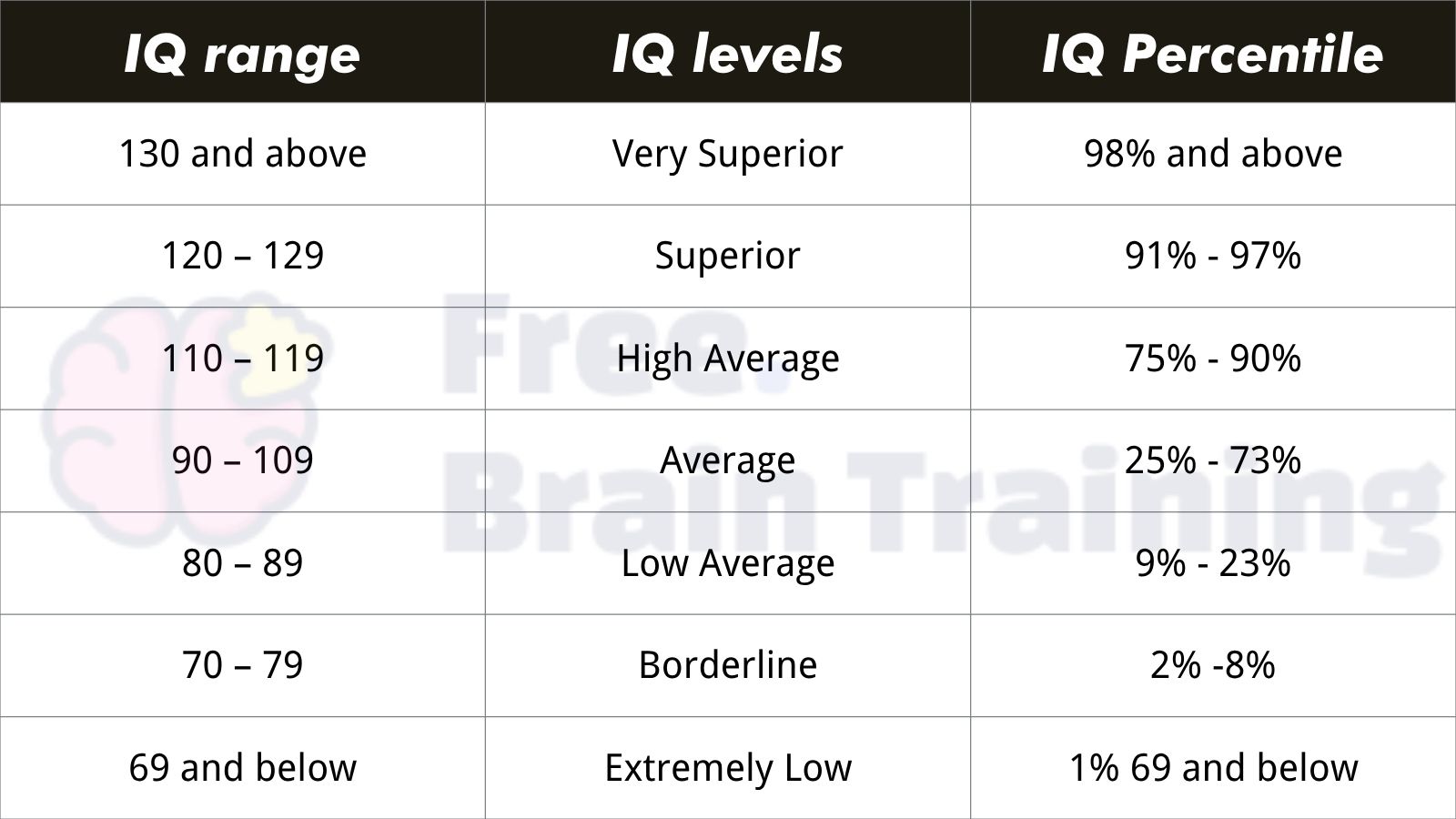
1. The Key to Interpretation: Your Percentile Rank
Let’s put aside just the base number for a second. The most important part of your IQ Score is the percentile rank the score falls into. This is the percentage of the population you scored higher than.
Here is a quick reference chart to compare any score:
2. The Connection to Academics, Career, and Success
Here is the million-dollar question: What does my IQ Score say about my life?
The relationship is complicated but meaningful. Research has consistently demonstrated that higher IQs are correlated with:
Academic Success: Higher IQs make for quicker learning and problem solving, which thus can lead to better academic grades, especially in early educational experiences.
Ability and Career Types: It may give an indicator that these individuals possess a natural predisposition for a certain type of work. Please see the table below.
Income: The average individual with a higher IQ will earn more in their lifetime.
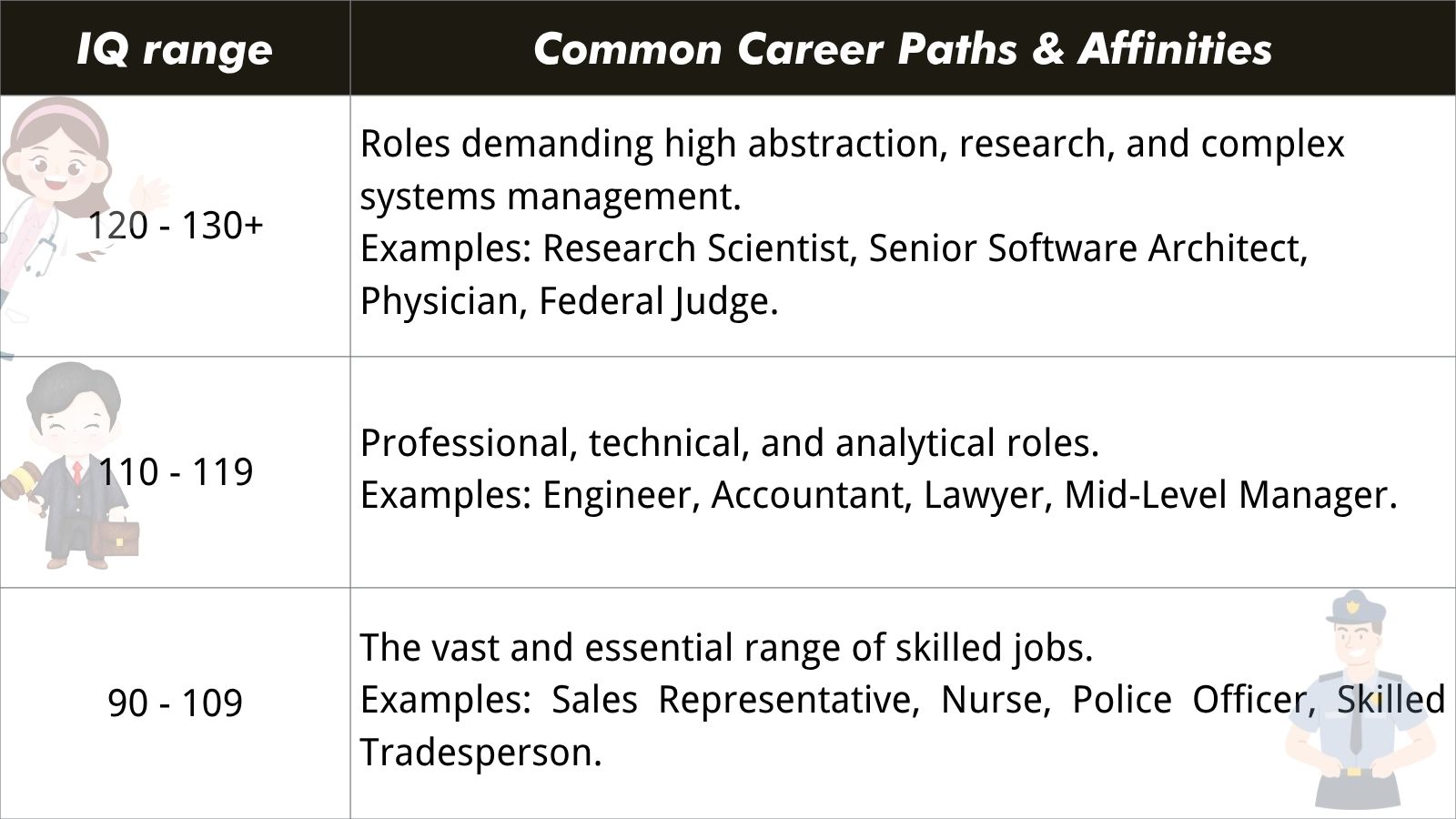
Potential Career Aptitudes by IQ Range
3. Is IQ Set in Stone? (Nature vs. Nurture)
Is your intelligence potential predetermined from birth? The scientific answer is no. It is an interactive phenomenon.
NATURE (Genes): Research reveals that genes account for roughly 50-80% of the variation in IQ between individuals. That establishes your potential range.
NURTURE (Environment): This is the empowering part of intelligence potential. The environment determines where you fall within your genetic potential range. In addition, valuable factors include the following:
- Quality of Education
- Early Childhood Nutrition
- Cognitive Stimulation (e.g., brain training, learning different skills)
- Socioeconomic Stability
The key takeaway: Your IQ is just a snapshot of your present or active cognitive capacity, not a life sentence. Genes are the building blocks fore IQ, but environment, habits, and purposeful brain training provide the tools you will need to create the strongest, most capable brain within your potential.
How to Improve Your Cognitive Health
Having a score is just the beginning; the real magic is to use that score to make you smarter and sharper. Think of your brain as a muscle - the more you specifically exercise it, the stronger it will become.
The Written Science of Neuroplasticity
Your brain is not hardwired. Every time you learn something new or challenge yourself, you solidify the communication channel in your brain. This capacity to be shaped, called neuroplasticity, is the scientific basis for showing you can improve your cognitive fitness at any age.
Targeted Brain Training
This is where a systematic brain training program is your brain's personal gym. Rather than playing a series of random games, you should find a program that incorporates individualized tasks that focus on the cognitive skills that the IQ test tests you on.
To Boost Working Memory: Work with games that involve sequencing, memory games, and N-back training. Working with these games will increase your brain's "RAM" and thus assist you with remembering names / tasks and more complex information much more easily.
To Enhance Processing Speed: Do quick reaction time games and quick-paced tasks with visual scans. This allows you to engage in quicker thinking and processing of information throughout your day.
To Sharpen Problem-Solving: You should practice solving logic puzzles and strategy-based games. These will improve your ability to fluidly reason through complex challenges at work and in your daily life with much greater ease.
Why a Program is Better:
Personalized Training: The best apps will develop a personalized workout plan that utilizes your first evaluation to perform better in your individualized areas of improvement.
Bite-Sized Sessions: Most programs will only require you to dedicate 3-5 minutes daily for your workout. You can fit this into your busy American lifestyle.
Progress Tracking: One of the motivating features of these apps is that you will be able to watch your cognitive index score charted over time through specific indicators. You can tailor your training to measure growth and improvement as you work on your cognitive tasks.
Sharpen Your Mind Now
The question "What is my IQ?" is more than just finding a number; it marks the beginning of a journey to better understand and improve the potential of your brain.
The best way to approach the IQ topic includes an initial, reliable baseline assessment - whether through a formal IQ test or an advanced cognitive benchmarking system combined with either on your own, or with a guide or facilitator, a science-supported training regimen.
Your brain is your most precious asset. Isn't it time to train it?
FAQ
Can I Really Improve My IQ Score?
Yes, to a significant level. Although inherited fluid intelligence is relatively stable, multiple studies have shown that cognitive abilities measured by IQ tests can be enhanced considerably with directed cognitive training, learning new skills, and maintaining an optimal mental state through healthy living.
Are Free Online IQ Tests Accurate?
They exist on a spectrum. Some from reputable sources give a useful estimate, with many, still not all, being limited and simple, moving to inflated scores to collect your data. Check tests that are open about their methods, terminology, and scoring.
What’s the Difference Between an IQ Test and Brain Games?
An IQ test is an assessment—it is like a Fitness test. Brain games and structured brain training are the workouts that you do to train yourself to improve your fitness. They can use the same cognitive skills; they are not opposed. The assessment tells you how you are, and the workouts help you improve to achieve better performance.
Disclaimer
Any assessments and their associated content on this website, regardless of date, are not intended to replace direct medical advice from your physician or other professional. If you experience severe or persistent symptoms, please consult a licensed mental health professional or healthcare provider.